Historical AI Images for Documentaries: 16 Klondike Scenes Tested
We made historical AI images for a Klondike documentary twice: one-line prompts vs dated scene lines. What went wrong in each, the fixes, and YouTube's rules.
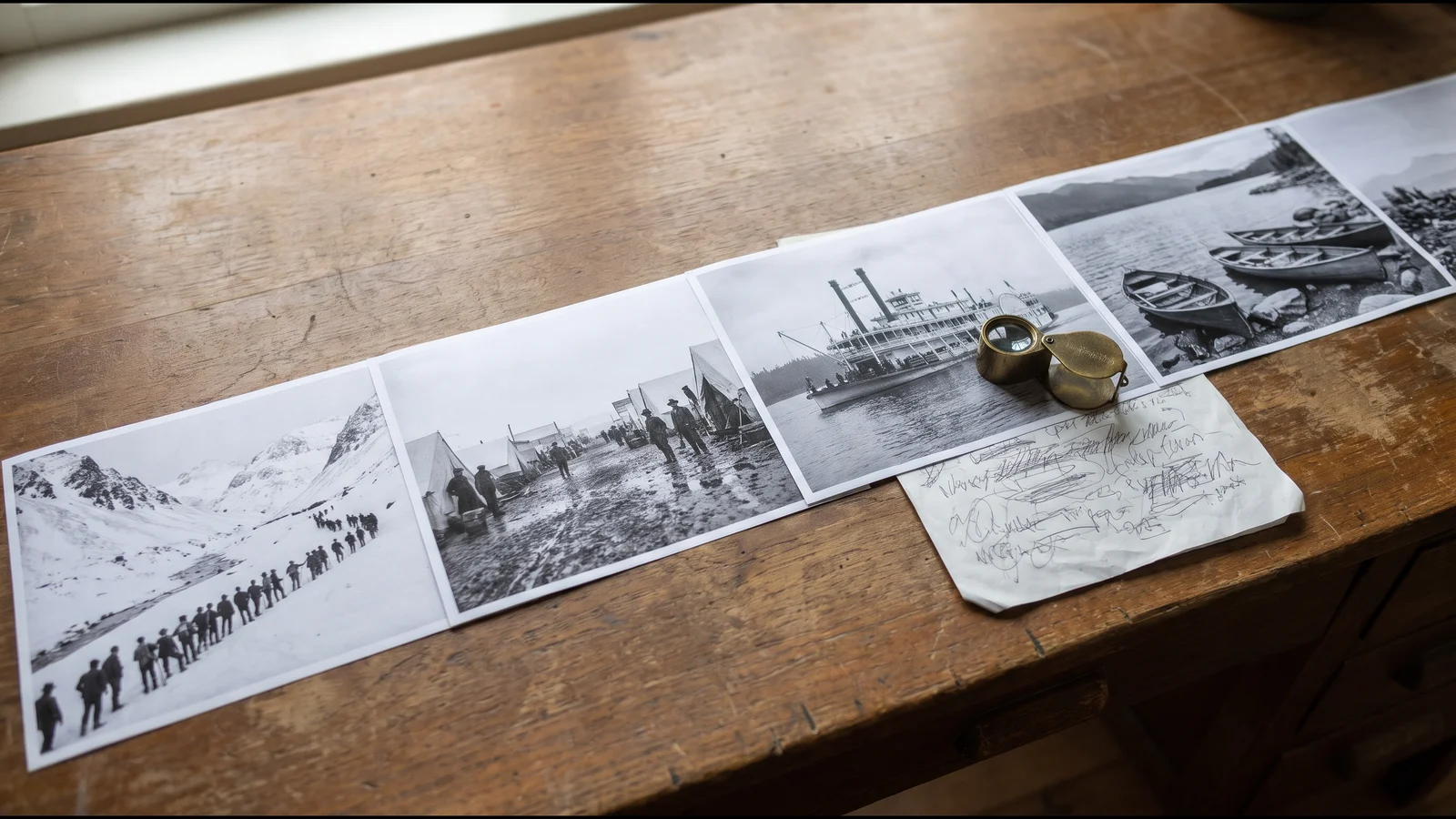
A history video lives or dies on its pictures. The narration says "spring 1898, Lake Bennett", and the frame on screen has to look like that place in that year. Not like a Western movie set, and not like a tourist photo of the same lake today. Real archive photos rarely cover every line of a script, so many history channels now fill the gaps with historical AI images, often 50 to 100 of them per video.
The trouble is that an image model fills in whatever you leave out, and it fills it in with the most common picture it knows. We wanted to see how much that matters, so we made the same eight scenes from the Klondike Gold Rush (1897–1898) twice in one go each: once with a one-line prompt per scene, once with a dated scene line. Every image in this post comes from those two runs and one small re-run. All people in them are AI-generated; none are real historical figures.
Genera imágenes por lotes
Un prompt por línea, cientos de imágenes, un ZIP para descargar.
How we tested#
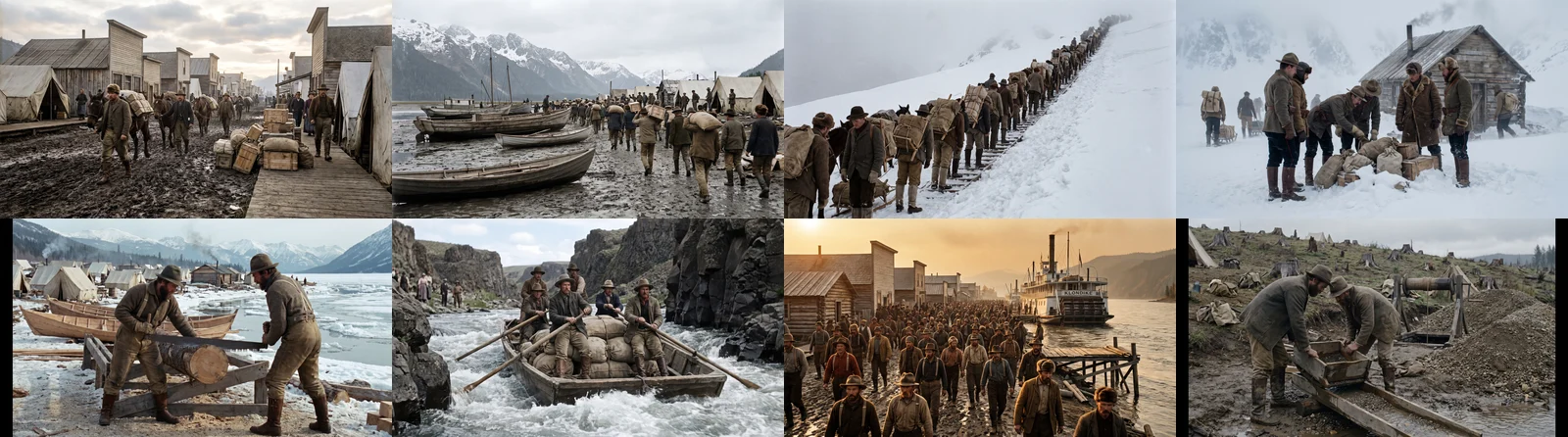
- Subject: eight scenes along the 1897–98 route to the Klondike: Skagway, the Dyea tidal flats, the Golden Stairs of the Chilkoot Pass, the Mounted Police check at the summit, boat building at Lake Bennett, the Miles Canyon rapids, Dawson City and a claim on Bonanza Creek.
- Model and settings: Nano Banana Pro, 2K, 16:9 (2752 × 1536 px), one image per scene, no re-rolls and no picking.
- Same style line on every prompt:
Cinematic historical documentary still, photorealistic, natural muted color, soft natural light, 35mm film grain. No text, no letters, no captions, no logos, no watermark. - Group A, one line: the style line plus a short caption, such as
Klondike Gold Rush: prospectors climbing the Chilkoot Pass. - Group B, dated line: the style line plus a scene line that starts with year, place, time of day and lens, then lists what is in the frame, then a period guard sentence (below).
Historical facts we checked against come from the US National Park Service pages for Klondike Gold Rush National Historical Park and Parks Canada, read in November 2026. Eight scenes, one run each, is a small sample. Treat the results as strong hints, not laws.
The surprise: no zippers#
We expected the classic AI mistakes: zippers, nylon backpacks, sunglasses, paved roads. We zoomed into all 16 frames and found none. Wool coats, felt hats, canvas packs, leather boots and wooden crates throughout, in both groups. The period guard sentence was not doing the heavy lifting, because the model already knew roughly what 1898 looks like.
What it did not know was which 1898. Group A pictures were believable gold rush pictures. They just weren't the scenes the script was talking about.
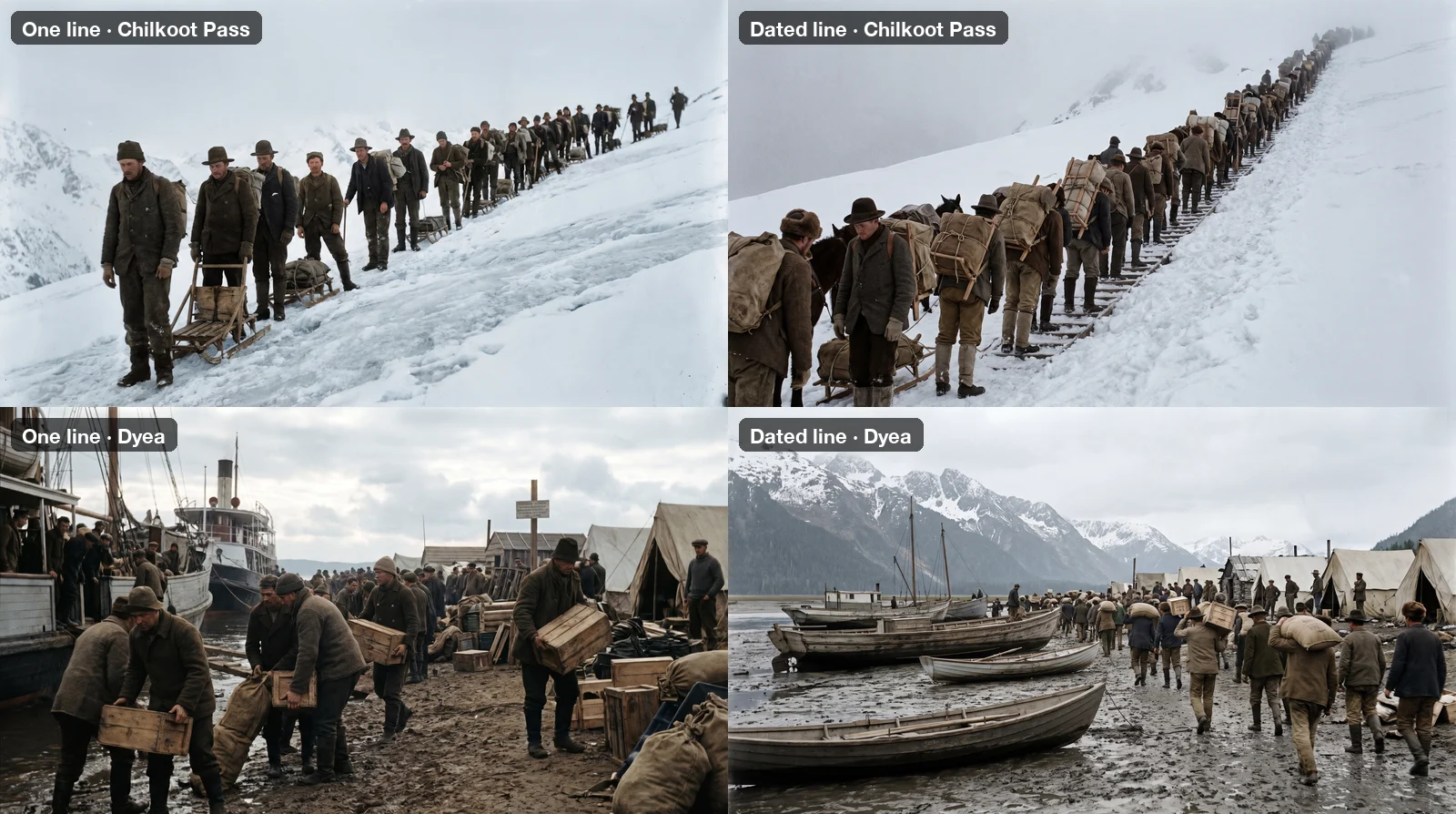
| Scene | Group A (one line) | Group B (dated line) |
|---|---|---|
| Chilkoot Pass | Men pulling sleds up a gentle snowfield | A single-file line up a steep slope, the famous view, but with wooden steps and horses |
| Dyea | A steamship tied up at a wharf | Boats stranded on the mud at low tide, as asked |
| Lake Bennett | A steam engine on the shore, open water | Ice on the lake, half-built boats, but the wrong saw (below) |
| Miles Canyon | A rowboat on a forest creek | A loaded scow between dark basalt walls |
| Dawson City | Tents and wagons, no river | A riverfront with a sternwheeler, but a name from 1937 (below) |
| Skagway, summit, Bonanza Creek | Generic but plausible | Matched the line |
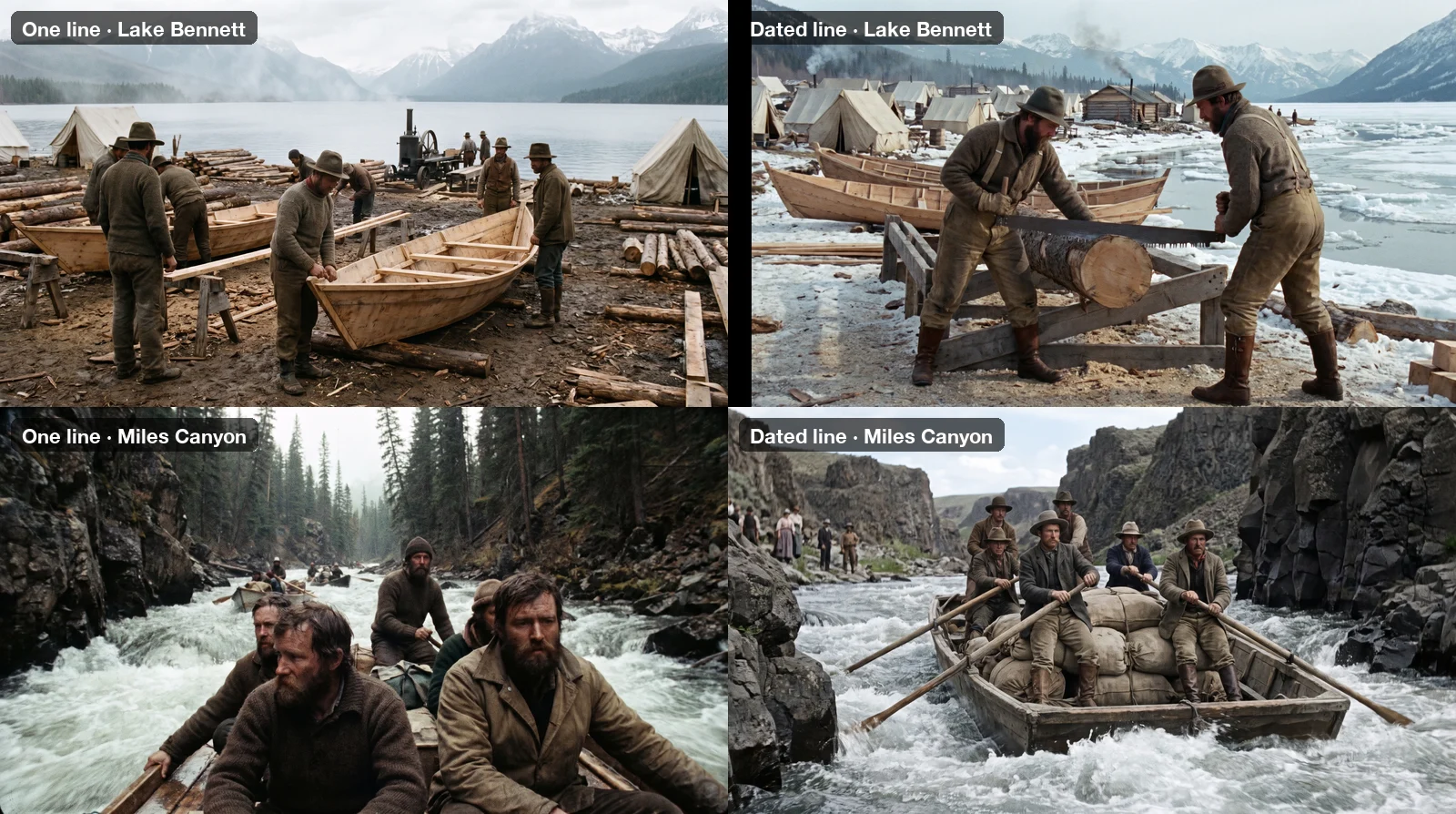
None of the Group A frames is "wrong" in a way a casual viewer would spot. That is the danger: a history audience includes people who know Miles Canyon is a basalt gorge on a big river, and they notice.
How to write a dated scene line#
Every Group B line follows the same order:
[Season and year], [exact place], [time of day / weather]. [Lens] [shot type]: [who is doing what], [2–4 physical details that only fit this place and moment].- Year and season first. "Winter 1898" put snow and fur coats on the Chilkoot. "Spring 1898" put ice on Lake Bennett, which matches the record: the lake stayed frozen until 29 May 1898.
- Exact place, not the event. "The Dyea tidal flats at low tide" gave us mud and stranded boats. "Unloading supplies at Dyea" gave us a generic harbour.
- Time of day and lens. These control mood and framing. A 200 mm telephoto shot stacked the climbers into the long line people know from archive photos.
- Physical details only this scene has. Basalt walls, a sternwheel steamboat, ice still on the water. These are what make a frame belong to your story.
Then add the period guard once at the end of every line. It cost nothing to include, even though our test never caught it in action:
Period-accurate for 1897-1898: wool and canvas clothing with buttons, felt hats and fur caps, leather boots, canvas packs; no backpacks with modern straps, no zippers, no synthetic fabric, no sunglasses, no plastic, no paved roads, no power lines, no modern vehicles or equipment.Change the years and the list for your own period. Then finish with your style line, the same on every line of the video.
Three mistakes the dated lines still made#
Being specific fixed the setting. It did not make the frames right. Zoomed in, three of the eight Group B frames had a real historical error.
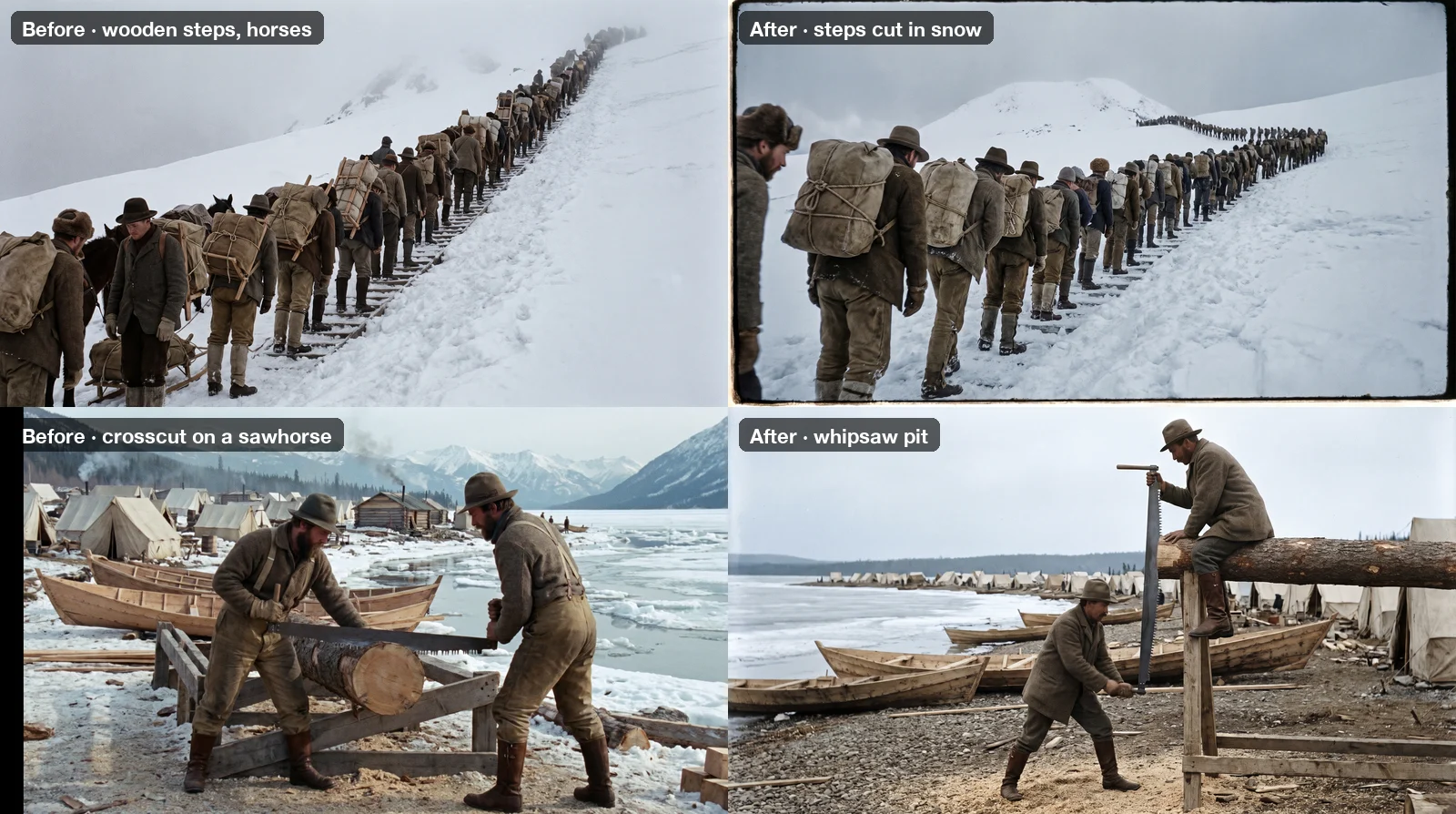
The Golden Stairs became a wooden staircase, with horses on it. We wrote "steps cut into the snow"; the model drew timber treads like a ladder, and put pack animals in the line. The stairs were carved into the snow and ice in early winter 1898, and until tramways were built, everything went up on people's backs. The fix that worked was to restate the material and say what is not there: The steps are cut into the snow itself: no wooden steps, no ladder, no railings, and no horses or other animals on the slope. The re-run got snow steps and no animals. It also made the slope gentler than the real one.
"Whipsawing" became a crosscut saw. The model knows "two men and a saw" but not what a whipsaw pit is. Stampeders at Bennett ripped logs lengthwise into planks: the log raised on a frame, one man on top, one underneath, pulling a long saw up and down. Spelling out that setup instead of using the trade word fixed it in one try. Rule of thumb: when a historical term is rare, describe the arrangement instead of naming it.
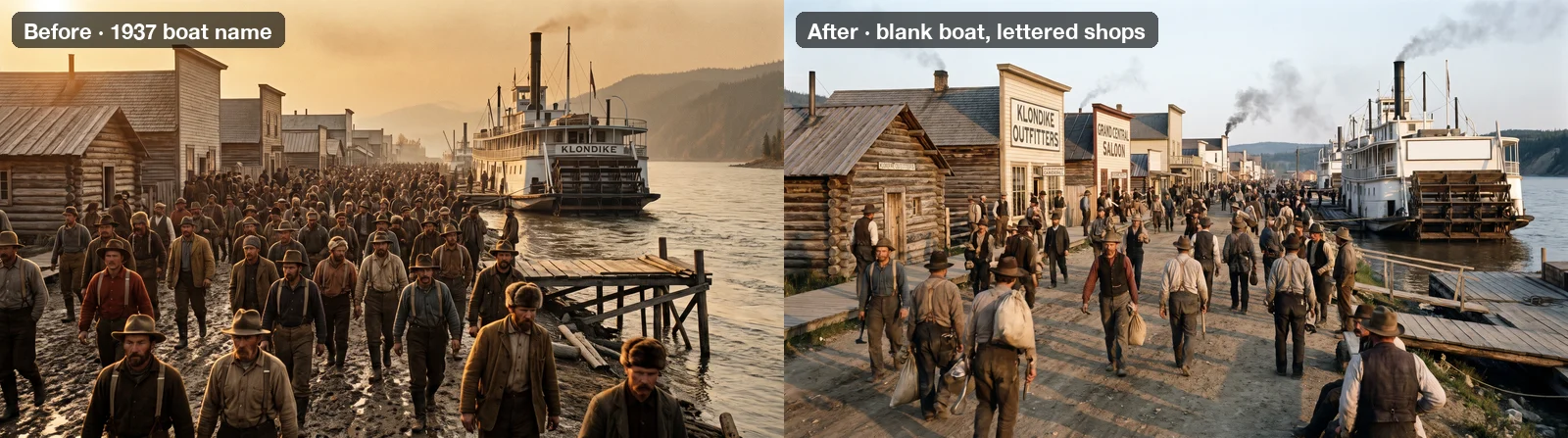
The steamboat got a name from 1937. Our style line said "no text". The model ignored it and painted KLONDIKE on the stern. The SS Klondike that Parks Canada preserves in Whitehorse was built in 1937, almost 40 years after the rush. In 1898, 57 registered steamboats docked at Dawson. The model reached for the one name everyone associates with the Yukon. Asking for blank name boards fixed the boat, but the letters moved to the street instead: Klondike Outfitters and Grand Central Saloon. Signs like those did exist in 1898, so it isn't an anachronism, but it shows that "no text" is a weak instruction.
Warning
Any lettering in a historical frame is a fact you didn't check: a ship's name, a shop sign, a date on a poster. Either ask for blank signboards and name boards on every line, or zoom in and verify what the model wrote.
Two more things to check#
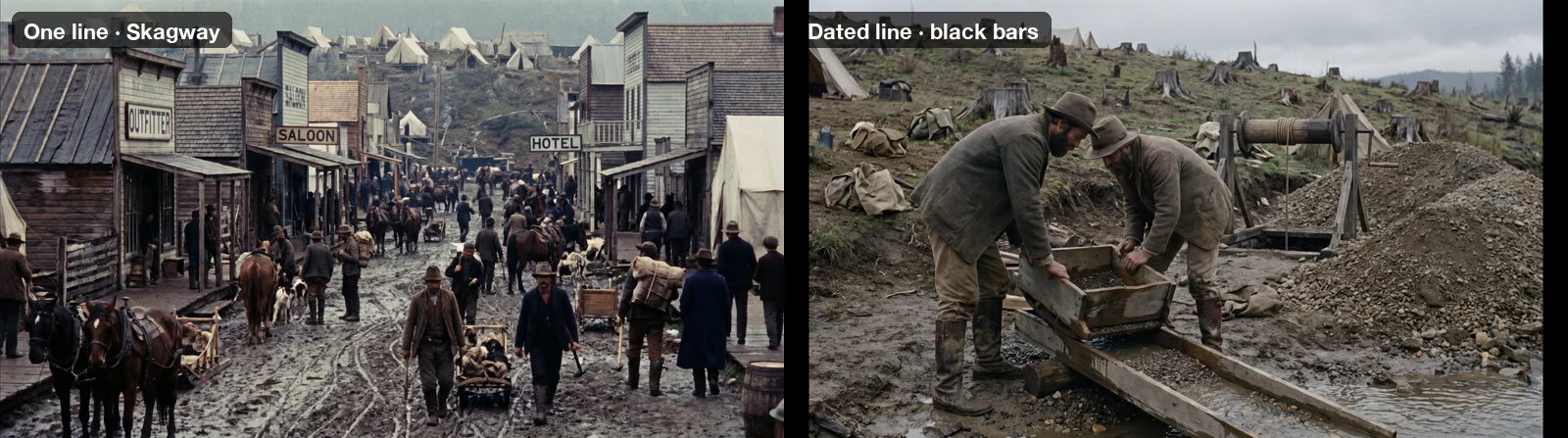
- Black bars. Three of 16 frames came back with black bars down the side, as if letterboxed. "Cinematic still" in the style line invites that. Adding
Full-bleed frame, no black bars, no letterboxing.removed the bars on all three re-runs, but one came back with a photo-print border instead (the "after" Chilkoot frame above). Check the edges of every frame; crop on download if needed. - Readable signs on one-line prompts. Group A's Skagway street had OUTFITTER, SALOON and HOTEL on the buildings despite the same "no text" line. The dated Skagway line, which asked for packhorses and crates rather than a "boomtown", came back without lettering.
The whole list, ready to run#
This is the dated batch with the three fixes folded in. Each line is one frame. It produces the eight scenes above in script order:
Fall 1897, Broadway in Skagway, Alaska, a muddy boomtown street, late afternoon. 35mm wide shot: unpainted wooden false-front buildings with canvas tents between them, stampeders in wool coats leading packhorses through deep mud, crates and sacks of supplies piled on the plank boardwalk. All signboards are blank. Period-accurate for 1897-1898: wool and canvas clothing, felt hats and fur caps, leather boots, canvas packs; no zippers, no synthetic fabric, no plastic, no paved roads, no power lines. Cinematic historical documentary still, photorealistic, natural muted color, 35mm film grain. Full-bleed frame, no black bars. No text, no letters, no logos.
1897, the Dyea tidal flats, Alaska, low tide, gray morning. 28mm wide shot: wooden scows and rowboats beached on the mud, men carrying sacks of flour and wooden crates ashore, snowy mountains behind, a few canvas tents. Period-accurate for 1897-1898: wool and canvas clothing, felt hats and fur caps, leather boots, canvas packs; no zippers, no synthetic fabric, no plastic, no paved roads, no power lines. Cinematic historical documentary still, photorealistic, natural muted color, 35mm film grain. Full-bleed frame, no black bars. No text, no letters, no logos.
Winter 1898, the Golden Stairs of the Chilkoot Pass, Alaska-British Columbia border, overcast day. 200mm telephoto shot up a steep slope: a single-file line of stampeders climbing steps chopped into the packed snow and ice, each bent under a heavy pack, the line reaching the summit. No wooden steps, no ladder, no railings, no animals on the slope. Period-accurate for 1897-1898: wool and canvas clothing, felt hats and fur caps, leather boots, canvas packs; no zippers, no synthetic fabric, no plastic. Cinematic historical documentary still, photorealistic, natural muted color, 35mm film grain. Full-bleed frame, no black bars. No text, no letters, no logos.
Winter 1898, the summit of the Chilkoot Pass, British Columbia side, blowing snow. 50mm shot: North-West Mounted Police officers in fur coats inspecting stacked sacks and crates half-buried in snow, a small wooden hut behind them. Period-accurate for 1897-1898: wool and canvas clothing, fur caps, leather boots; no zippers, no synthetic fabric, no plastic. Cinematic historical documentary still, photorealistic, natural muted color, 35mm film grain. Full-bleed frame, no black bars. No text, no letters, no logos.
Spring 1898, the shore of Lake Bennett, British Columbia, cold clear morning. 35mm shot: a whipsaw pit, a log raised on a high log frame at head height, one man on top of the log and one man underneath it, pulling a long vertical saw to rip the log lengthwise into planks; half-built wooden boats on the shore, a tent city along the lake, ice still on the water. Period-accurate for 1897-1898: wool and canvas clothing, felt hats, leather boots; no zippers, no synthetic fabric, no plastic, no power tools. Cinematic historical documentary still, photorealistic, natural muted color, 35mm film grain. Full-bleed frame, no black bars. No text, no letters, no logos.
June 1898, Miles Canyon on the Yukon River, Yukon, bright day. 50mm shot from the canyon rim: a homemade wooden scow loaded with sacks shooting through white-water rapids between dark basalt walls, men pulling on long oars. Period-accurate for 1897-1898: wool and canvas clothing, felt hats, leather boots; no life jackets, no zippers, no synthetic fabric, no plastic. Cinematic historical documentary still, photorealistic, natural muted color, 35mm film grain. Full-bleed frame, no black bars. No text, no letters, no logos.
Summer 1898, Front Street in Dawson City, Yukon, low evening sun. 35mm wide shot: a crowded dirt street of log cabins and wooden false-front saloons, a sternwheel steamboat moored at the riverbank, men in wool shirts and suspenders. The steamboat's name boards and all shop signs are blank. Period-accurate for 1897-1898: wool and canvas clothing, felt hats, leather boots; no zippers, no synthetic fabric, no plastic, no paved roads, no power lines. Cinematic historical documentary still, photorealistic, natural muted color, 35mm film grain. Full-bleed frame, no black bars. No text, no letters, no logos.
Summer 1898, a claim on Bonanza Creek near Dawson City, Yukon, overcast day. 50mm shot: two miners rocking a wooden rocker box beside a plank sluice, a hand windlass over a shaft, piles of gravel, cut tree stumps on the hillside. Period-accurate for 1897-1898: wool and canvas clothing, felt hats, leather boots; no zippers, no synthetic fabric, no plastic, no machinery. Cinematic historical documentary still, photorealistic, natural muted color, 35mm film grain. Full-bleed frame, no black bars. No text, no letters, no logos.
Note
We tested the three fixes one line at a time. The shortened guard and the "all shop signs are blank" sentence in this list are untested starting points: run one or two frames first, then the whole list.
Running a whole script in one batch#
A real video has 50 to 100 of these lines. Writing them one at a time in a chat app is where most of the work goes, and where the style drifts between frames. In a bulk image generator the whole script runs as one job:
- Paste the scene list, one line per frame, in narration order. Keep the period guard and style line identical on every line. Our guide to AI images for YouTube videos covers turning a script into that list.
- Set Aspect ratio 16:9, resolution 2K, Images per combo 1. One frame per scene. Our 2K frames came out at 2752 × 1536 px, enough to crop or slow-zoom at 1080p.
- Pick the model. We used Nano Banana Pro at 6 credits a frame at 2K. The models page compares price and style.
- Check the estimate. The form shows Will generate N images · X credits before anything is charged; credits are spent only when you press Start batch. Each plan has a per-batch image limit, so for a long video run one batch per chapter. Pricing lists the limits.
- Check every frame, then fix only the bad ones. Try again redraws one frame and leaves the rest of the batch alone. Images that fail to generate are refunded automatically.
- Download all gives one ZIP numbered in the order of your list, so the files sit in script order on the timeline.
If a person recurs through the video, such as an explorer or a ship's captain, attach a reference image so the face stays the same. Our consistent character guide shows how.
What YouTube asks of history channels#
YouTube's rules, read on its help centre in November 2026, matter more for history content than for most niches:
- Disclosure. YouTube requires creators to disclose AI-generated content "that seems realistic", including content that "generates a realistic scene that didn't actually occur." Its examples don't mention historical reconstructions, but a photorealistic frame of 1898 Dawson City is a realistic scene no camera recorded. Our reading: if your frames look like photographs, tick Yes under the AI use setting in YouTube Studio. YouTube says disclosure alone "won't limit a video's audience or impact its eligibility to earn money." Search suggestions show viewers asking whether history channels use AI; a label answers them before the comments do.
- Monetisation. YouTube's monetisation policy excludes "image slideshows, templated storylines, or scrolling text with minimal or no narrative, commentary, or educational value" and AI content "giving the impression of mass production without adding the creator's original, authentic insights or perspective." The images support your research and narration; they can't replace it.
Checklist for your next history video#
- Every scene line starts with season/year, exact place, time of day and lens.
- Each line names two to four physical details only that moment has.
- Rare historical terms are described, not just named (a whipsaw pit, not "whipsawing").
- The period guard and style line are identical on every line.
- Signboards and name boards are blank, or you have checked every word.
- Every frame is zoomed in and compared with an archive photo or a park service page before it goes on the timeline.
- Black bars and print borders are cropped.
- Photorealistic videos are marked as AI-generated in YouTube Studio.
FAQ#
Which AI model is best for historical images? We tested only Nano Banana Pro here, because it gave the most photographic texture in our earlier tests. Period clothing was right in all 16 frames. The errors we found came from vague prompts and rare terms, which no model will guess for you. Compare models on two or three of your own scene lines before running a whole script.
Do historical AI images need to be labelled on YouTube? YouTube requires disclosure for realistic AI content, including scenes that didn't actually occur. Its examples don't cover historical reconstructions specifically, so this is our reading, not YouTube's wording: if the frames look like photographs, disclose them.
Can I make the images look like old photographs instead of colour film? Yes. Change the style line, for example to a sepia glass-plate photograph look, and keep it the same on every line. We tested colour only; run a few frames before the whole script.
How many images do I need for a 10-minute history video? Roughly one per sentence or short paragraph of narration, which usually means 60 to 100 frames. Run them as one batch per chapter so a single bad line doesn't hold up the rest.
Why not just use real archive photos? Use them wherever they exist. They are the most convincing frames you can have, and many are public domain. AI frames fill the moments no one photographed. Check each AI frame against those archive photos.